01 40 00 Quality Requirements
Find Section 01 40 00 Quality Requirements in Division 01 and see how to coordinate testing, inspection, and reporting across project sections.
Quick answer
Project manuals use 01 40 00 for Quality Requirements in Division 01, General Requirements. Start here for procedures that apply across trades, such as arranging tests, notifying the testing agency, and distributing reports. The applicable technical sections and other governing project documents give the criteria and requirements for specific work.
Example: planning a concrete placement
A superintendent preparing for a concrete placement reviews the quality requirements for the notice period, who arranges testing, and how reports are submitted. The team then checks the concrete section and applicable drawings for the tests required for that placement and the project’s acceptance criteria.
Put the notice deadline, planned placement, and responsible contact on the lookahead schedule. Check whether the testing agency needs the mix reference or placement location in advance. After placement, file the reports with the corresponding pour and record the action required for any result the project team flags for review.
Put each obligation with its source
- Coordination procedures. Check Division 01 for notification, access, report distribution, and any procedures for scheduling additional tests.
- Technical requirements. Check the specification section for the material or installation being tested and the criteria for reviewing results.
- Responsibility and cost. Confirm who engages the testing agency and who pays for initial testing or retesting under the project documents.
Track testing through acceptance
For work that will be covered, coordinate the inspection date with the installation sequence and any required hold points. Record the location or lot covered by each report so the field team and design team can identify which work the result applies to. If an inspection is missed or a test fails, use the project’s reporting and resolution procedures and keep the disposition with the original record. This makes it possible to review what was tested, what follow-up was required, and whether the responsible party completed it.
Verify the section in CSI Dynamic Standards
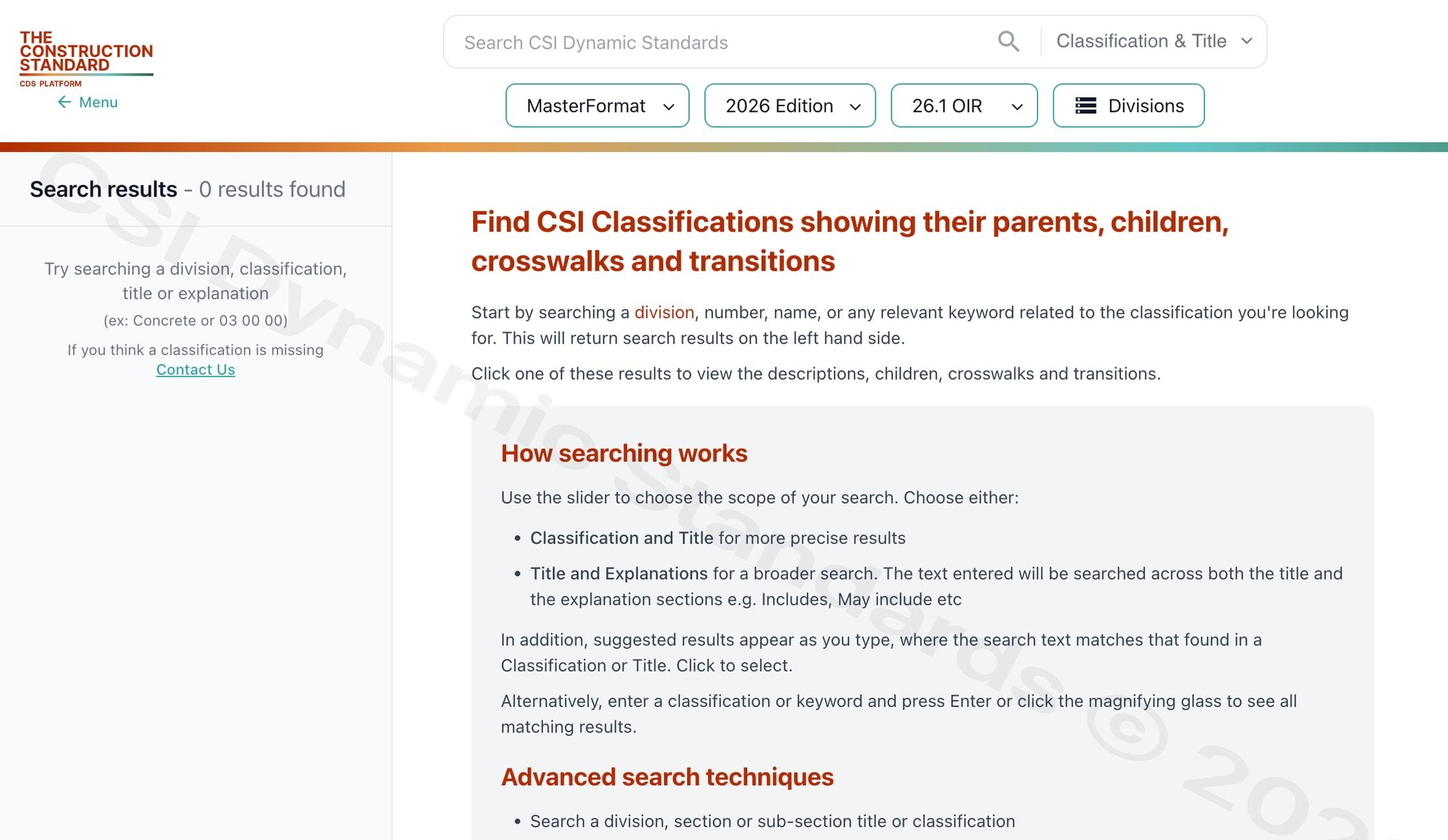
In CSI Dynamic Standards search, enter 01 40 00. Compare the number and title with the MasterFormat edition used for the project. If the project manual uses a different title, search by the work description as well, and compare the nearby results before selecting a reference.
An edition change and a project addendum answer different questions. The edition identifies how the work is classified. The addendum can revise what a team must price or deliver. If you are reusing an office master or an estimate from another job, compare both the classification and the current scope before carrying over the reference. Record which documents you checked and when, especially if another team will use the same reference later for procurement or field review.
Keep the section number and title printed in the project manual when recording a bid item, submittal, or field question. If you also track a classification for a different edition, record that separately so your team can trace the decision back to the original project documents. Browse the parent MasterFormat division for related work, or see CSI section number lookup for help finding other references. Sign up for access to use the platform.
Access Current CSI Standards
CSI Dynamic Standards provides authorized access to MasterFormat, UniFormat, and OmniClass through a connected, edition-aware platform. Create an account to view access options, or review pricing for organization-wide standards use.
Sources and review scope
Reviewed against CSI’s public standards information for scope, terminology, and licensing context. This public guide provides orientation and does not reproduce or replace the licensed standard. Content review date: November 10, 2026.
People also search for
Explore closely related CSI divisions, standards, and construction classification topics.
Access MasterFormat®, UniFormat®,
and OmniClass®

123 N Pitt St. Suite 450
Alexandria, VA 22314info@theconstructionstandard.com